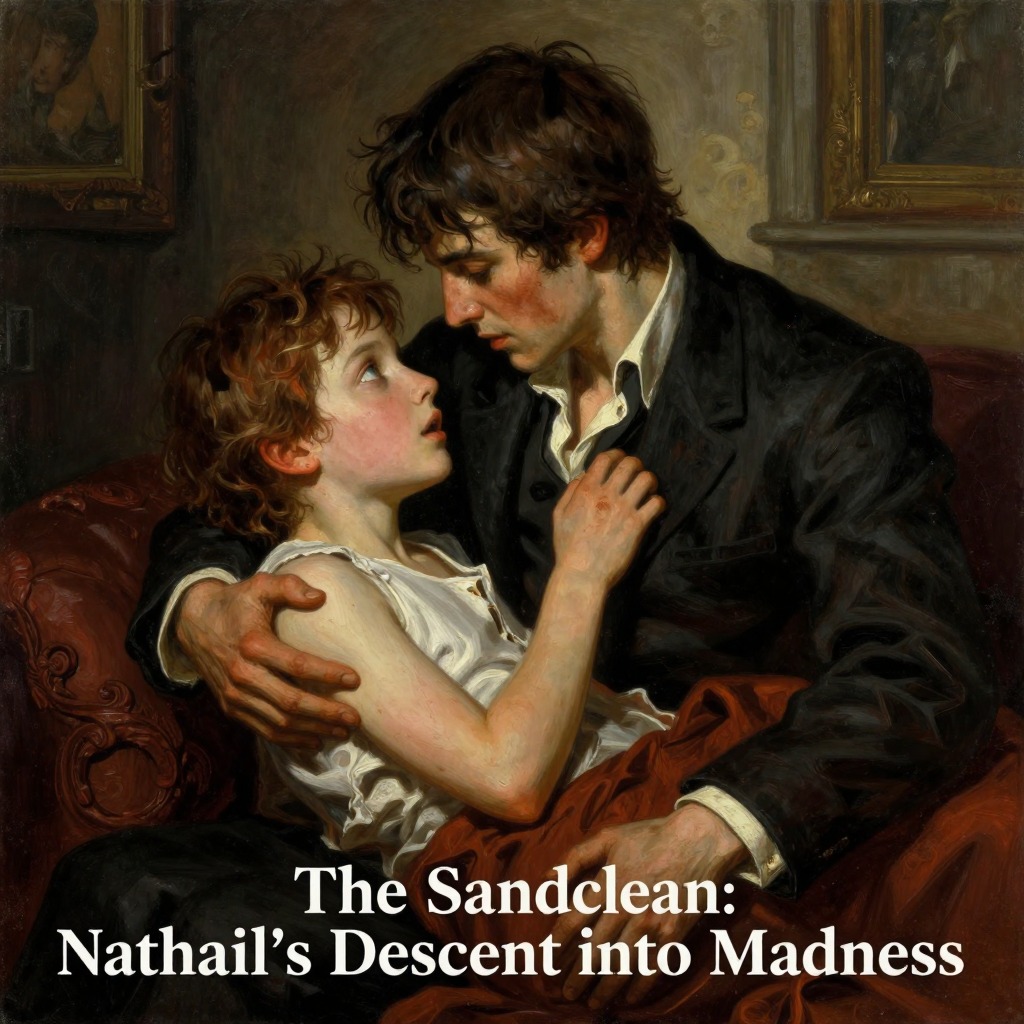
Dance with Olympia
The Dance with Olympia marks the climax of Nathaniel's infatuation with Professor Spalanzani's daughter and the moment when his psychological break with reality becomes unmistakable. At a lavish party and concert hosted by Spalanzani, Olympia appears in public for the first time, and Nathaniel, using the looking-glass he purchased from the optician Coppola, becomes utterly captivated by her. The dance itself, and the events surrounding it, transform Nathaniel's romantic longing into a delusion that isolates him from the world and sets him on a path toward destruction.
The Setting and the Looking-Glass
Spalanzani's party is a grand affair, with carriages rolling up to the door and lights shimmering in the elegantly decorated rooms. The company is numerous and glamorous. Olympia appears richly and tastefully attired, and everyone admires her finely chiselled face and graceful figure, though some note a measured stiffness in her stance and step, which they ascribe to the stress of appearing in society. The concert begins, and Olympia plays the grand piano with great skill and sings a bravura aria with a clear, almost bell-glass-like, pitch-perfect voice. Nathaniel, standing in the last row, cannot clearly make out her features in the candlelight. Without attracting notice, he pulls out Coppola's looking-glass and gazes through its lens at the lovely Olympia. Through the glass, he fathoms how ardently she peers in his direction, and every note seems to sound enveloped in a loving look that surges through his burning heart. The artful trills ring in his ear like the heavenly Hosannas of the spirit transfigured by love. When the long trill pierces the air, he feels as though suddenly enveloped by her warm embrace and, no longer able to control himself, cries out in rapture and pain: 'Olympia!' All heads turn to look at him, some laughing.
The Dance and Its Uncanny Qualities
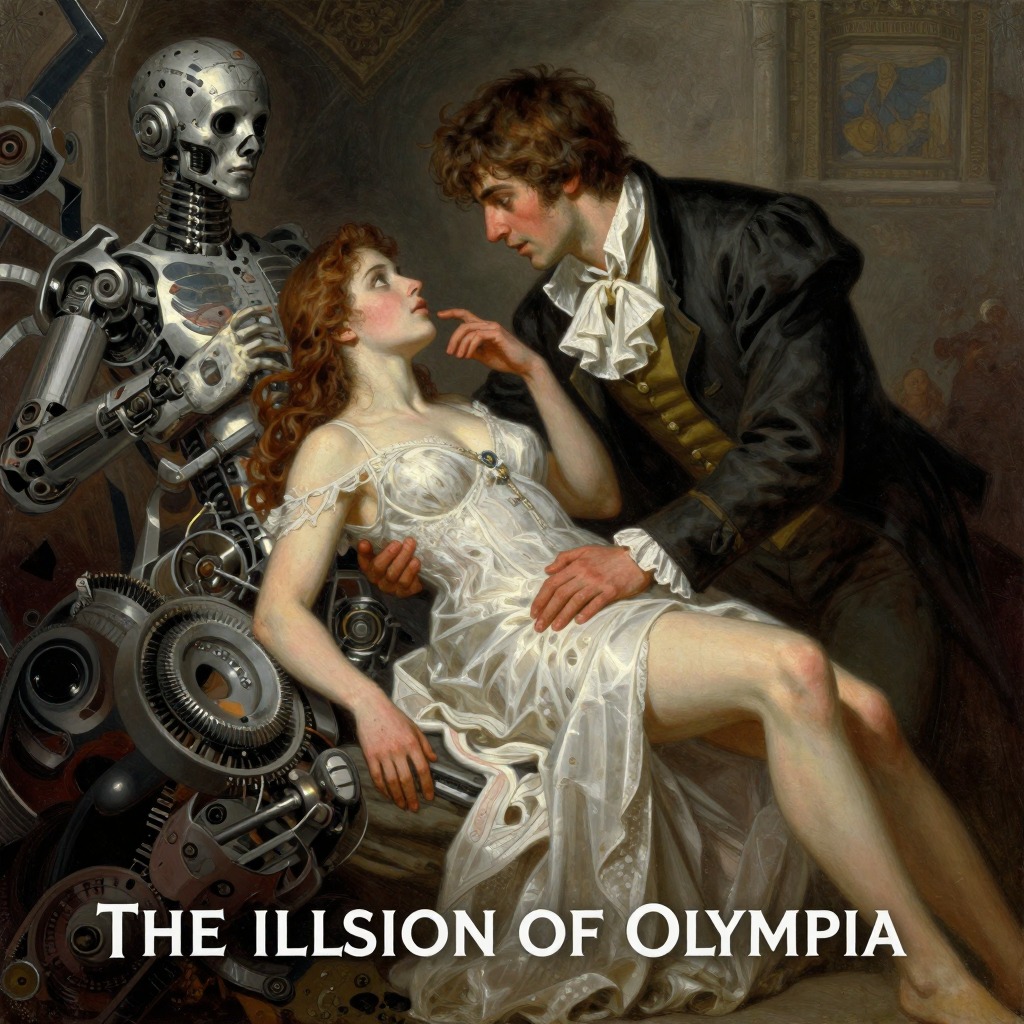
After the concert, the ball begins. Nathaniel's deepest desire is to dance with Olympia, and he finds himself standing right beside her, hardly able to stammer a few words before reaching for her hand. Olympia's hand is ice-cold; he feels a terrible deathly frost surge through him. He looks into her eyes, which greet his gaze with love and longing, and at that very moment it is as if the pulse begins to beat in her cold hand and the lifeblood begins to glow warm within. Love's longing wells up, glowing hotter and hotter in Nathaniel's breast. He wraps his arm around Olympia and leads her down the rows of dancers. He had always thought himself a good dancer, able to hold to the beat, but from the precise rhythmic steadiness of Olympia's step, which often causes him to falter, he soon fathoms the failing of his own sense of beat. Yet he no longer wants to dance with any other woman in the world and feels as if he would have killed anyone else who dared approach her to ask for a dance. This happens only twice, and thereafter, to his amazement, Olympia always remains seated between dances, and he does not hesitate to reach for her hand and pull her up again and again. Had Nathaniel had eyes for anything but the lovely Olympia, countless tussles and tangles would have been unavoidable, for clearly the quiet, painstakingly muffled laughter that emanates here and there among the groups of young people is directed at the lovely Olympia, whom they follow with the strangest looks.
The One-Sided Conversation
Fired up by the dance and by the wine of which he has pleasantly partaken, Nathaniel sheds his innate shyness. He sits beside Olympia, his hand in hers, and speaks fervently of his love for her in words that neither he nor she understands. She peers without flinching right into his eyes and sighs again and again: 'Oh – Oh – Oh!' Nathaniel replies: 'Oh you beautiful, heavenly woman! You ray of hope from the Promised Land of love – you deep spirit in which my entire being is mirrored,' and more of the same. In response, Olympia keeps sighing the same 'Oh, Oh!' Professor Spalanzani walks several times past the blissful pair and smiles with a strange look of satisfaction. Though Nathaniel's spirit hovers elsewhere in another world, all of a sudden it seems to him as if it grows curiously dark down below in Spalanzani's house; he looks around and fathoms with a start that the last two lights in the empty hall are burning down to the wick and threaten at any moment to go out. Music and dance have stopped long ago. He cries out in a wild and desperate voice, kisses Olympia's hand and leans forward to kiss her on the mouth with his burning lips, but her lips are ice-cold. Just as when he first touched Olympia's cold hand, he feels a shudder run through him, the legend of the dead bride suddenly flashing through his mind. But Olympia presses him tightly to her, and in that kiss her lips seem to come alive with warmth. Spalanzani paces slowly through the empty hall; his steps sound muffled and, ringed by dancing shadows, his figure appears terrifying and ghostlike. Nathaniel whispers: 'Do you love me – do you love me, Olympia? Just that one word! Do you love me?' Olympia, standing up, only sighs: 'Oh! Oh!' Nathaniel declares his love, and Olympia responds again with 'Oh, Oh!' before walking away. Nathaniel follows her, and they stand before the Professor, who smiles and invites Nathaniel to visit whenever he likes.
Consequences and Significance
The Dance with Olympia is the event that seals Nathaniel's fate. It is the moment when his subjective reality, mediated by Coppola's looking-glass, completely overrides objective perception. The dance itself is a grotesque parody of romantic union: Nathaniel feels a deathly frost from Olympia's hand, yet interprets it as the beginning of life; he hears the muffled laughter of the other guests but ignores it; he receives only the monosyllabic 'Oh, Oh!' in response to his passionate declarations, yet he reads profound love into it. The scene functions as a peripeteia, a tragic reversal: what Nathaniel believes to be the fulfillment of his deepest longing is in fact the beginning of his complete psychological collapse. The dance also serves as an anagnorisis for the reader, who, through the reactions of the other guests and the uncanny details of Olympia's stiffness and silence, begins to understand that Olympia is not a living woman but an automaton. Nathaniel's cry of 'Olympia!' in the concert hall, his obsessive dancing, and his one-sided conversation all mark him as a man who has lost his grip on reality, and the event sets the stage for the later revelation that Olympia is a lifeless doll, a revelation that drives Nathaniel into madness.